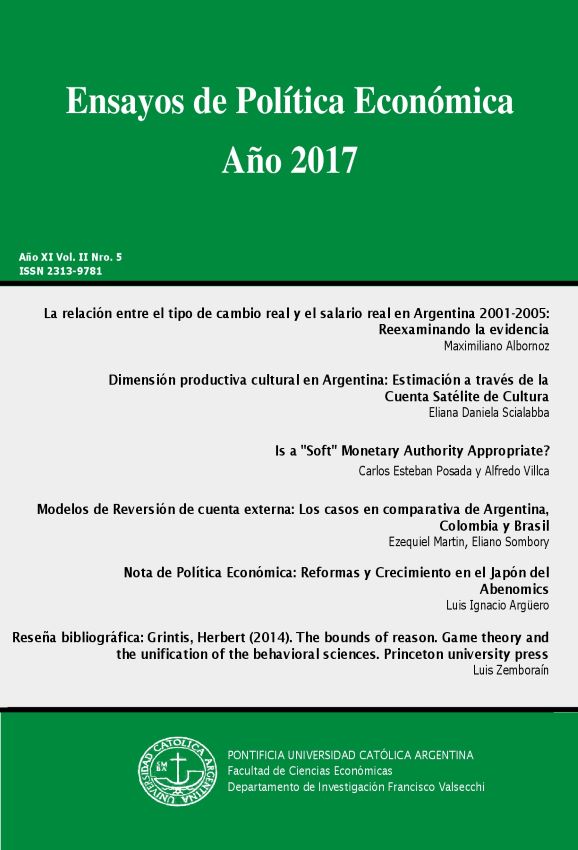
[RETRACTED ARTICLE] External Account Reversion Models: Cases in comparison of Argentina, Colombia and Brazil
Keywords:
reversal of current account deficit, Logit model, data panel, ArgentinaAbstract
The present work examines the principal determinants of the reversion of the trade deficit, across a review of the theoretical corpus and the empirical work. The quantitative analysis was realized by means of the model Logit, whose database consists of the report of 138 countries during 1970-2011. This treatment allows establishing the principal reasons and macroeconomic variables that affect the current account reversal (CAR). Likewise, this paper contemplates a comparative analysis of Argentina, Colombia and Brazil of the pre-established and relative probabilities of occurrence of episodes CAR with acceleration and deceleration of the economic growth (CARA and CARD).Downloads
References
Adalet, M. y B. Eichengreen (2006), “Current Account Reversals: Always a Problem?”, in R. Clarida (ed.), G7 Current Account Imbalances: Sustainability and Adjustment, The University of Chicago Press, Chicago.
Algieri, B. y T. Brake (2007), “Patterns of Current Account Adjustment Insights from Past Experience”, Working Paper Series No 762, European Central Bank.
Baumann Fonay, I. y Cohan, L. (2018), “Crecimiento Económico, PTF y PIB Potencial en Argentina”, Documento de Trabajo No 1, Ministerio de Economía de la Nación.
Barone, S., R. Descalzi y A. Díaz Cafferata (2008), “Probability of Current Account Reversals in Argentina and other Latin American Countries”, XLIII Reunión Anual de la AAEP, Noviembre de 2008.
Benhima, K. y O. Havrylchyk (2006), “Current Account Reversals and Long Term Imbalances: Application to the Central and Eastern European Countries”, CEPII Working Papers No. 27, December.
Calvo, G. (2014), “Sudden Stop and Sudden Flood of Foreign Direct Investment: Inverse Bank Run, Output, and Welfare Distribution”, Scandinavian Journal of Economics 116(1), pp. 5-19, 2014.
Cardarelli, R. y A. Rebucci (2007), “Exchange Rates and the Adjustment of External Imbalances”, World Economic Outlook, Chapter 3, International Monetary Fund, Washington, D.C.
Corden, W.M. (1994), Economic Policy, Exchange Rates, and the International System. Oxford: Oxford University Press.
Croke, H., S. Kamin y S. Leduc (2005), “Financial Market Developments and Economic Activity during Current Account Adjustments in Industrial Countries”, International Finance Discussion Papers 827, Board of Governors of the Federal Reserve System, Washington D.C.
De Haan, L., H. Schokker y A. Tcherneva (2006), “What do current account reversals in OECD countries tell us about the US case?”, DNB Working Paper Series No. III, August, De Nederlandsche Bank, Amsterdam.
Debelle, G. y G. Galati (2005), “Current account adjustment and capital flows”, BIS Working Papers 169, February.
Edwards, S. (2002), “Does the Current Account Matter?” In E. Sebastian and J. Frankel (eds.): Preventing Currency Crises in Emerging Markets, NBER Conference Report Series. University of Chicago Press, pp. 21-69.
Edwards, S. (2005), “Capital Controls, Sudden Stops and Current Account Reversals”, NBER Working Paper Series 11170.
Feenstra, R., R. Inklaar y M. Timmer (2015), “The Next Generation of the Penn World Table”, American Economic Review 105(10), pp. 3150-3182.
Freund, C. (2005), “Current Account Adjustment in Industrialized Countries”, Journal of International Money and Finance 24(8), pp. 1278-1298, December.
Freund, C. y F. Warnock (2006), “Current Account Deficits in Industrial Countries: The Bigger They Are, The Harder They Fall?”, in R. Clarida (ed.), G7 Current Account Imbalances: Sustainability and Adjustment, The University of Chicago Press, Chicago.
Komárek, L. y M. MeleckÁ½ (2005), “Currency Crises, Current Account Reversals and Growth: The Compounded Effect for Emerging Markets”, Warwick Economic Research Papers 735.
Komárek, L., Z. Komárková y M. MeleckÁ½ (2005), “Current Account Reversals and Growth: The Direct Effect Eastern Europe 1923-2000”, Warwick Economic Research Papers No 736.
Milesi-Ferretti, G.M. y A. Razin (1998), “Sharp Reductions in Current Account Deficits”, European Economic Review 42, pp. 897-908.
Obstfeld, M. (2012), “Does the Current Account Still Matter?”, NBER Working Paper 17877.
Obstfeld, C. (2013), “Current Account Reversals in Industrial Countries. Does the Exchange Rate Regime Matter?”, Working Paper Series 1547, European Central Bank.
Sachs, J. (1981), “The Current Account in the Macroeconomic Adjustment Process”, NBER Working Paper 796.
Scott Long, J. y J. Freese (2014), Regression Models for Categorical Dependent Variables Using Stata, Stata Press Publication.
Sturzenegger, F., P. Guidotti y A. Villar (2003), “Aftermaths of Current Account Crisis: Export Growth or Import Contraction?”, Business School Working Papers, Universidad Torcuato Di Tella, Buenos Aires.
Downloads
Published
Issue
Section
License
 Make a Submission
 Language
 Information