
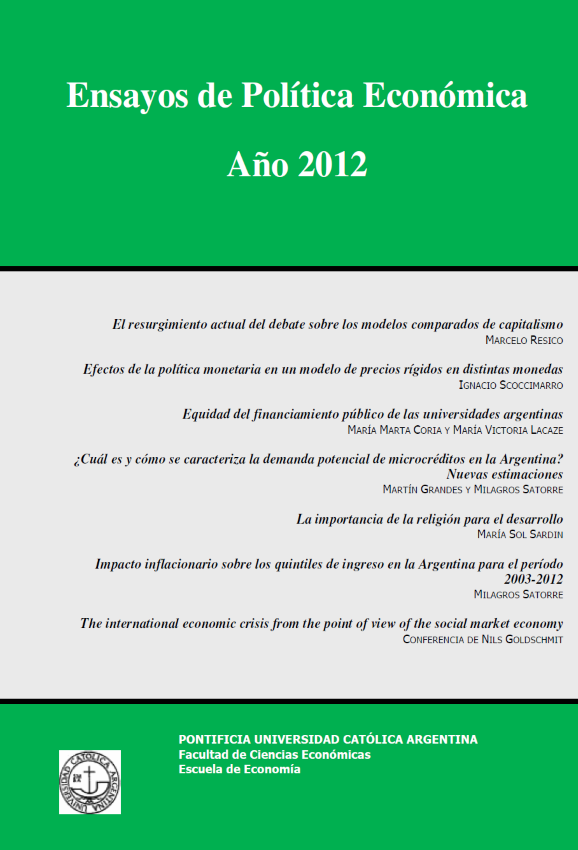
The importance of religion for development. An empirical analysis from the Mincer equation
Keywords:
economy, human development, welfare, religion, religiosityAbstract
The document studies, through an amplified version of the Mincer equation that incorporates religion (belief and level of religious practice), the incidence of religion and religiosity on economic development and the well-being of people in Argentina. Three different models were made to capture what happens when the definition of development is amplified through income, living conditions and general well-being. Being very religious, Jewish, or practicing, even a little, other religions, has a negative effect. Being a practitioner has a positive effect. Religion and religiosity have less effect on the subsistence index. Being a practitioner is associated, in most
religions, with a better satisfaction index. Given these specifications and applied methodology it has not been possible to determine whether being an atheist or a believer is a relevant distinction to well-being. Future in-depth investigations will be made and are recommended.
References
Acemoglu, D., S. Johnson and J. Robinson (2005). “Institutions as a
Fundamental Cause of Long Run Growth”, P. Aghion and S. Durlauf (eds.),
Handbook of Economic Growth, vol. 1A, Elsevier, North Holland, 386-472.
Barro, R. (2002). “Cantidad y calidad del crecimiento económico”,
Economía Chilena, agosto 2002, Volumen 5. No. 2.
Besley, T. and M. Ghatak (2010). “Property Rights and Economic Development”, D. Rodrick and M. Rosenzweig (eds.), Handbook of Development Economics. Vol. 5. Elsevier, 4525”4595.
Cárdenas Martínez, R. (2006). “Economía y religión – dos visiones sobre el desarrollo económico”.
Diaz-Dominguez, A.(2009). “Nota metodológica: midiendo religión en encuestas de Latinoamérica”, Perspectivas desde el Barómetro de las Américas. No.29.
Fitzgerald, M. (2009). “Satan, the great motivator. The curious economic effects of religion”.
Grier, R. (1997). “The Effect of Religion on Economic Development: A Cross National Study of 63 Former Colonies”, KYKLOS, Vol. 50, Fasc. 1, 47 – 62.
Grim, B. and Finke, R. (2007). “International Religion Indexes:
Government Regulation, Government Favoritism, and Social Regulation of Religion”, Interdisciplinary Journal of Research on Religion.
Guiso, L., Sapienza, P. and Zingales, L. (2002). “People´s opium? Religion and economic attitudes”.
Iannaccone, L. R. and Everton, S. F (2004). “Never on Sunny Days: Lessons from Weekly Attendance Counts”.
Lehrer, E. L. (2008). “The Role of Religion in Economic and Demographic Behavior in the United States: A review of the recent literature”, IZA DP No. 3541.
Lehrer, E. L. (2009), “Religion, Human Capital Investments and the Family in the United States”, IZA DP No. 4279.
Davood Manzoor (2004). “Economics of Religion: the role of religion on economic performance. A review of literature”.
McCleary, R. M. and Barro, R. J. (2003). “Religion and Political Economy in an International Panel”, Harvard University.
McCleary, R. M. and Barro, R. J. (2003). “Religion and Economic Growth”, Harvard University.
McCleary, R. M. and Barro, R. J. (2003). “International determinants of religiosity”, Working Paper 10147.
North, D. C. (1990), “Institutions, institutional change and economic
performance”, Cambridge: Cambridge University Press.
Observatorio de la Deuda Social Argentina, Departamento de Investigación Institucional, UCA (2005). Barómetro de la Deuda Social Argentina, número 1. “Las grandes desigualdades”, Buenos Aires, Educa.
Pessino, C. (1995). “Returns to education in Greater Buenos Aires 1986-1993: from hyperinflation to stabilization”. CEMA.
Pita Barros, P. and Garoupa, N. (2002). “An Economic Theory of Church Strictness”.
Welch, P. and Mueller, J.J. (2001). “The relationships of religion to
economics”. Review of Social Economy.
Downloads
Published
Issue
Section
License