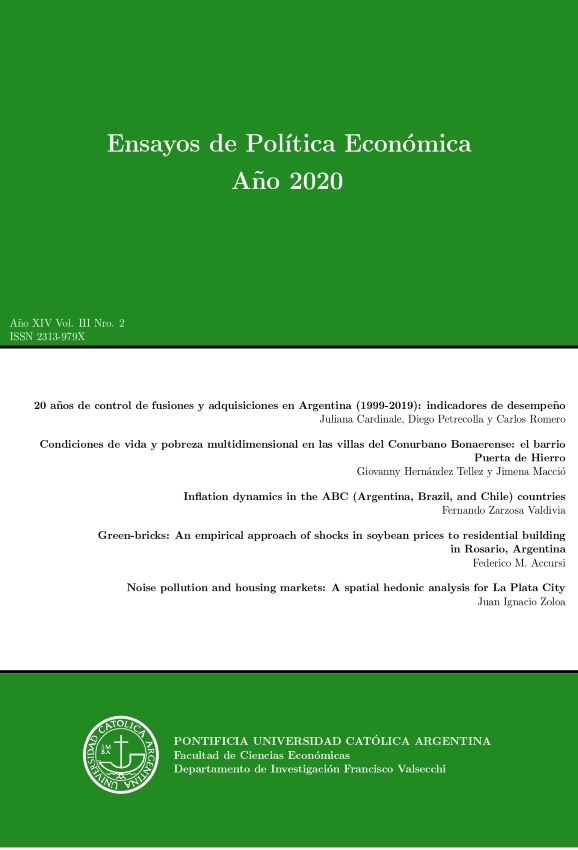
Green-bricks: An empirical approach of shocks in soybean prices to residential building in Rosario, Argentina
DOI:
https://doi.org/10.46553/ensayos.3.2.2020.p101-128Keywords:
price shocks, commodities, VAR, impulse response function, real estateAbstract
Shocks in commodity prices affect developing countries not only on their macroeconomic aggregates, but also on specific industries. The aim of this paper is to study the impact of international soybean prices on the construction activity in Rosario, epicenter of the most fertile area in Argentina, a major soybean producer. VAR methodology is used and accounts for a positive effect in the period 1994-2018. The time path of the effect would be along the first year and a half, when the elasticity of a transitory impulse in soybean prices ranges between 0.69 a 0.96.
Downloads
References
Bai, Jushan (1997). “Estimating multiple breaks one at a time”. Econometric Theory, Volume 13, Issue 3 June 1997, pp. 315-352.
Bai, Jushan and Perron, Pierre (1998). “Estimating and testing linear models with multiple structural changes”. Econometrica, Vol 66, No.1 (Jan 1998), 47-78.
Bebczuk, Ricardo; Garegnani, María Lorena (2012). “Real State as Housing and as Financial Investment: A First Assessment for Argentina”. Documento de Trabajo N° 95. November 2012. Universidad Nacional de La Plata (UNLP).
Bus, Ana y Nicolini, José (2010). “Medición de la renta diferencial agrícola en Argentina en 1986-2008”. Anales de la Asociación Argentina de Economía Política (AAEA). XLV Reunión Anual. November 2010.
Céspedes, L.F., and Velasco A (2012). “Macroeconomic Performance During Commodity Price Booms and Busts”, NBER Working Paper 18569, Issued in November 2012. National Bureau of Economic Research, Cambridge, MA.
Compañía Argentina de Tierras. Website: http://www.cadetierras.com.ar/valores-yestadisticas/valor-alquileres-agricolas/
Elliott, G. R., T. J. Rothenberg, and J. H. Stock (1996). “Efficient tests for an autoregressive unit root”. Econometrica Vol 64, N° 4 (July 1996), pp.813–836.
Enders, Walter (2004). Applied Econometric Time Series. Ed. John Wiley & Sons. Second Edition.
Evenett, S. J., & Jenny, F. (Eds.). (2012). Trade, competition, and the pricing of commodities. Centre for Economic Policy Research.
Friedman, M. (1957). The permanent income hypothesis. In A theory of the consumption function (pp. 20-37). Princeton University Press.
Grimes, G. & Hyland, S. (With Coleman, A., Kerr, J. and Collier, A. (2013). “A New Zealand Regional Housing Model”, Working Paper 13-02. Wellington: Motu Economic and Public Policy Research.
Hamilton J. D. (1994). Time Series Analysis. New Jersey: Princeton University Press.
Koitsiwe, Kegomoditswe and Adachi, Tsuyoshi (2015). “Australia mining boom and Dutch disease: analysis using VAR method”. Procedia Economics and Finance 30 (2015) 401-408. 3rd Economics & Finance Conference, Rome, Italy, April 14-17, 2015 and 4th Economics & Finance Conference, London, UK, August 25-28, 2015.
Lapelle, Hernán; López Asensio, Guillermo; Woelflin, María Lidia (2011) “El sector construcción-inmobiliario a una década de la crisis 2001”. Decimosextas Jornadas de “Investigación en la Facultad” de Ciencias Económicas y Estadística (UNR), 2011.
Lütkepohl, H., Saikkonen, P., & Trenkler, C. (2001). Maximum eigenvalue versus trace tests for the cointegrating rank of a VAR process. The Econometrics Journal, 4(2), 287-310.
Lüktepohl, H. and Kratzig, Markus (2005) “VECM analysis in JMulTi”. Available http://www.jmulti.de/download/help/vecm.pdf
Lüktepohl, Helmut (2005) New Introduction to multiple time series analysis. Springer.
Muñoz, Ercio (2013) “Precio de materias primas y spread soberano en economías emergentes, ¿importa la concentración de las exportaciones?”. Working paper n°684, 2013. Central Bank of Chile.
Ng, S., and P. Perron (1995). “Unit root tests in ARMA models with data-dependent methods for the selection of the truncation lag”. Journal of the American Statistical Association Vol 90, N° 429 (March 1995), pp: 268–281.
Pedersen, Michael (2015). “The Impact of Commodity Price Shocks in a Major Producing Economy”. The Case of Copper and Chile. Working Paper N°753, 2015. Central Bank of Chile.
Phillips, P. C. B., and P. Perron (1988). “Testing for a unit root in time series regression”. Biometrika (1988),75,2, pp.: 335–346.
StataCorp, 2017. Stata: Release 15. Stata Glossary and Index. Stata press.
Sing, Michael; Edwards, D.J.; Liu, Henry J. X. and Love, P. (2015). “Forecasting Private-Sector Construction Works: VAR Model Using Economic Indicators”. Journal of Construction Engineering and Management. Vol 141 Issue 11-November 2015.
Zivot, E. and Andrews, D. (1992). “Further evidence on the Great Crash, the oil price shock, and the unit-root hypothesis”. Journal of Business and Economic Statistics July 1992, Volume 10, N°3, pp. 251-70.
Downloads
Published
Issue
Section
License
 Make a Submission
 Language
 Information