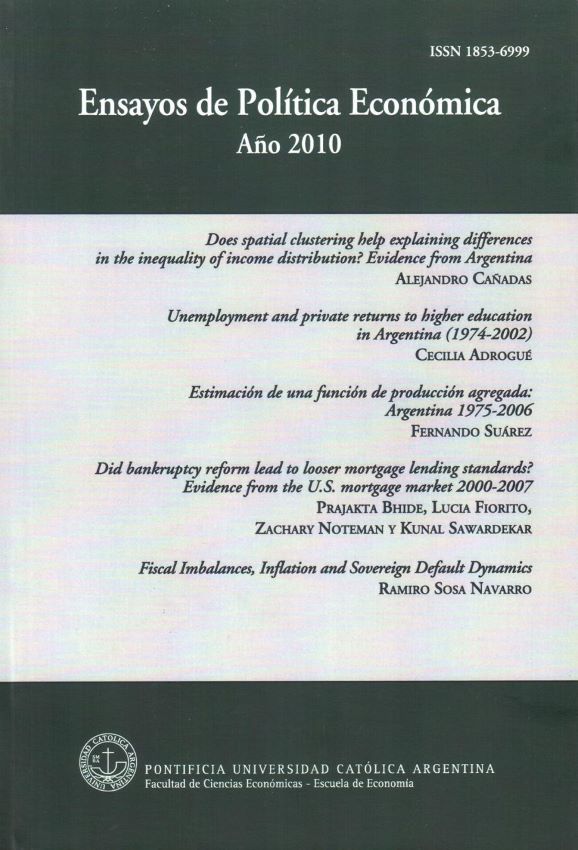
Unemployment and private returns to higher education in Argentina (1974-2002)
Keywords:
Returns to higher education, unemploymentAbstract
The paper analyzes the private returns to higher education in Argentina during the period 1974–2002. The main conclusion is that returns to education are positive and increase once corrected by the level of unemployment. As a consequence, when analyzing whether to invest in education, one should not only consider as benefits the differential in earnings, but also the higher probability of having a job that comes with attaining more education. This is particularly relevant in a country like Argentina which had unemployment rates of 5% during the eighties and started to have unemployment rates in the double digits by the end of the 20th century and the beginning of the 21st century.
Downloads
References
Ashenfelter, Orley and John Ham (1979), “Education, Unemployment and Earnings” in Journal of Political Economy 87 (5) II pp. 99-116.
Barro, Robert J. (1989), “Economic Growth in a Cross Section of Countries” WP 201, Harvard University.
Becker, Gary (1964), Human Capital, NBER.
Boissiere, Maurice, John Knight and Richard Sabot (1985), “Earnings, Schooling, Ability and Cognitive Skills” American Economic Review Vol. 75 (5), pp. 1016-1030.
Encuesta Permanente de Hogares, INDEC. Several Waves. FIEL (2002), Competitividad, “Capital humano y educación para el crecimiento”, Buenos Aires.
Glewwe, Paul (2002), “Schools and Skills in Developing Countries: Education Policies and Socioeconomic Outcomes”, Journal of Economic Literature Vol. 15, June, pp. 436-482.
Hansen, Gary (1985), “Indivisible labour and the business cycle” Journal of Monetary Economics, 16 pp. 309-325.
Harmon, Colm, Hessel Oosterbeek and Ian Walker (2003), “The Returns to Education: Microeconomics”. Journal of Economic Surveys, Vol. 17, pp. 115-156.
Hungerford, T and G. Solon (1987), “Sheepskin Effects in the Return to Education”, Review of Economics and Statistics, Vol. 69, pp. 175-177.
Krueger, Alan B. and Mikael Lindahl (2001): “Education for Growth: Why and for Whom?”, Journal of Economic Literature Vol. 39 (4) pp. 1101-1136.
Layard, Richard and George Psacharopoulos (1974), “The Screening Hypothesis and the Returns to Education”, Journal of Political Economy, 82 (5) pp. 985-998.
Lee Hansen, G (1963), “Total and Private Rates of Return to Investment in Schooling”, Journal of Political Economy, April, Vol. 71 (2), pp. 128-140.
Llach, Juan J. and Silvia Montoya (2000), Educación para todos, IERAL.
Llach, Lucas (1996), “Beneficios de la educación en presencia de alto desempleo: El caso de Argentina”, Universidad Torcuato Di Tella, May.
Margot, Diego (2001), “Rendimientos a la educación en Argentina: Un análisis de cohortes”. WP No. 33, Facultad de Ciencias Económicas Universidad Nacional de La Plata, July.
Meghir, Costas and Marten Palme (2004), “Educational Reform, Ability and Family Background”, The Institute for Fiscal Studies, WP04/10, 21st September.
Mincer, Jacob (1974), Shooling, Experience and Earnings, New York, NBER.
Ministerio de Educación Ciencia y Tecnología, Secretaría de políticas universitarias, Anuario 1999-2003 Estadísticas Universitarias.
OECD (2005), Education at a Glance, Paris.
Paz, Jorge A. (2004), “Education, Gender and Youth in the Labor Market in Argentina”, WP Nº. 272, CEMA, September.
Pessino, Carola (1995), “Returns to Education in Greater Buenos Aires 1986-1993: From Hyperinflation to Stabilization”, WP Nº.104, CEMA, June.
Sianesi, Barbara and John Michael Van Reenen (2003), “The Returns to Education: Macroeconomics”. Journal of Economic Surveys, Vol 17, pp. 157-200.
Spence, A. Michael (1973), “Job Market Signaling”, Quarterly Journal of Economics, Vol. 87 (3), pp. 355-374.
Solow, Robert (1980), “On theories of Unemployment”, American Economic Review, 70(1) pp. 1-11.
Sosa Escudero, Walter (2005), “Aproximaciones económicas y econométricas para la problemática educativa”, WP N°.17, Escuela de Educación de la Universidad de San Andrés, August.
Streb, Jorge Miguel (2002), “Job Market Signaling under Two-dimensional Asymmetric Information”, Mimeo. July.
Tobias, Justin L. and Li, Mingliang (2004), “Returns to Schooling and Bayesian Model Averaging: A Union of Two Literatures”. Journal of Economic Surveys, Vol. 18 (2) pp.153-180.
Downloads
Published
Issue
Section
License
 Make a Submission
 Language
 Information